HOUSE BOUND OR TALKING ‘BOUT MY GENERATOR

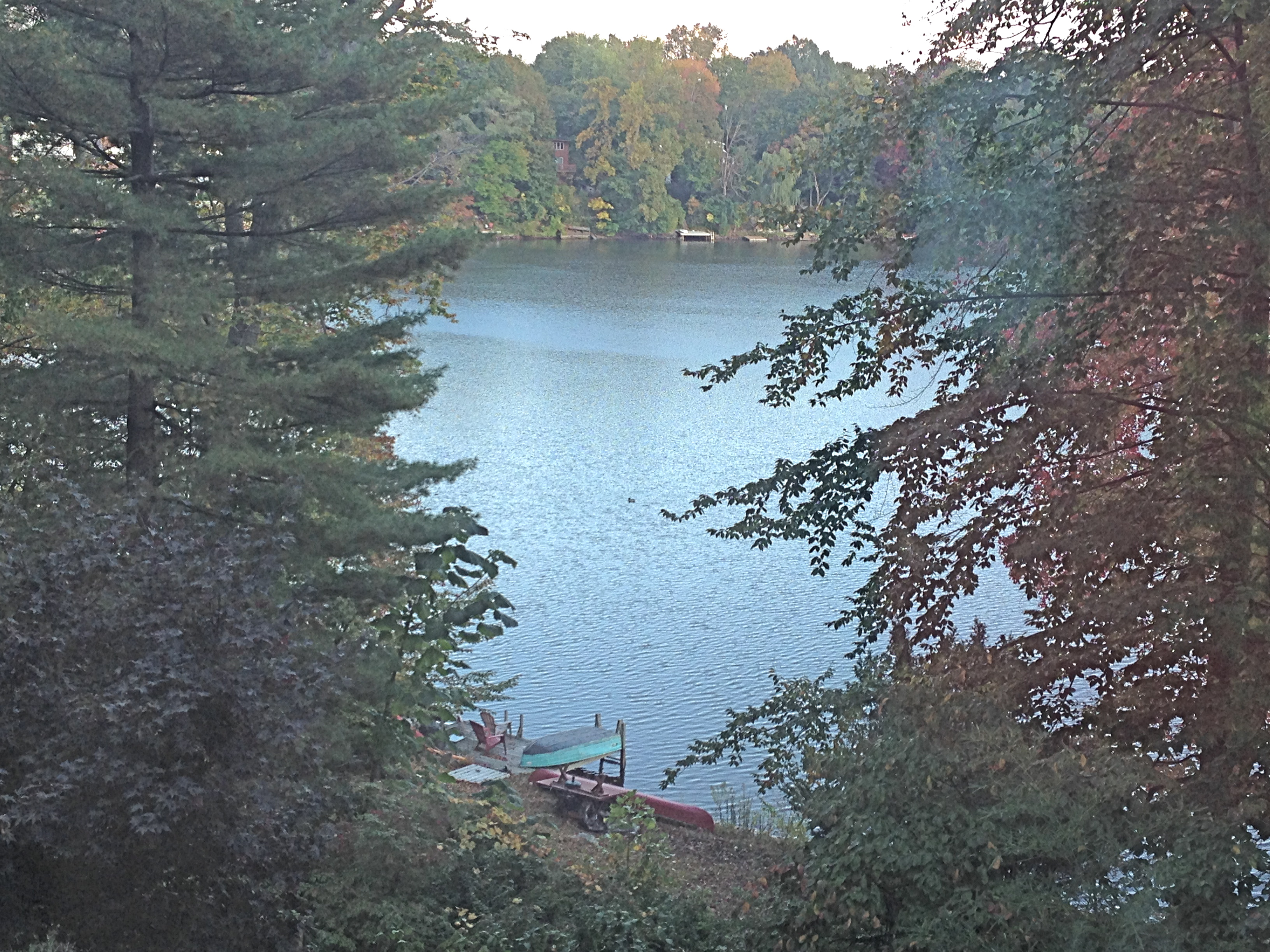
Life on a lake takes on new meaning during the winter months, especially our view from the kitchen window. With the absence of leaves the vista expands and the black branches are a stark contrast to the now frozen water crusted with thin white snow. A red tailed hawk circles overhead, waiting.
Image

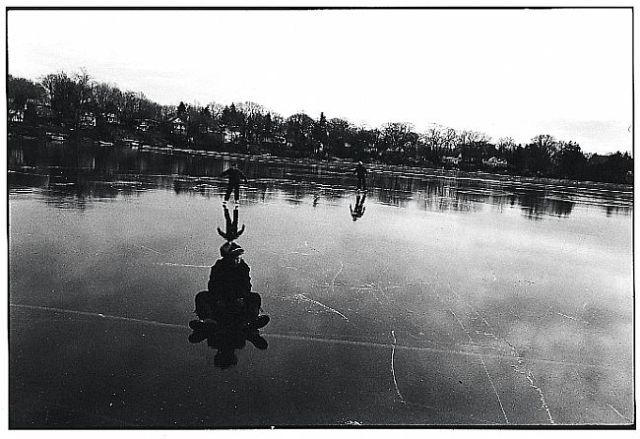
Black ice before the first snowfall. ©Robert Forlini

After the first leaf season ended we settled into what we believed would be an almost sublime skate across a wide open sheet of black ice. This would be followed by a cozy scene of a happy family toasting marshmallows in front of the open fire while the snow floated past the picture window. Who could ask for anything more from winter?

During one of our tours of the house before buying it the owner highlighted all the selling points. The house had new windows, it was wired with an alarm system and oh yes, it was wired for a generator.

As city transplants we cocked our heads and asked, “Why?”

“Just in case the power ever goes out,” she said.

“Does that happen often?”

“No, but best to be prepared,” she said.

A thinking person would have investigated this a little further and asked around. Instead we looked at the large red metal box on two wheels and asked, “Is it difficult to use?”

The owner, a petite woman weighing no more that 100 pounds answered. “Oh no, it’s so easy. I simply wheel it outside that door, plug it in and it starts right up.”

I know what you’re thinking. Did you ask her to demonstrate it? Wrong again.

A few days before the sale was final the husband of the petite woman talked Rob and I through a series of steps to hook up the generator.

“Okay, now first you have to shut off the mains.”  He pointed to the circuit breaker.

“All of them?”

“Oh yeah, if you don’t shut this down you’re likely to blow up the place when the real power comes back on.”

“We wouldn’t want that,” I said.

“Then you wheel the generator out, fill it with six gallons of gas, but you better have extra tanks of gas on hand,” He said.

“Extra?”

“You wouldn’t want to run out.”

“Now after you plug it in, click this,” he moved his hand quickly past a small, black nondescript button. “Then adjust the choke, you gotta fiddle with it sometimes, then just pull the crank until it starts. Piece of cake.”

Again you would think we would have asked him to actually demonstrate it. I looked at Rob with a concerned face. “Do you understand this?”

The owner, a man we later always referred to as “the Strunz,” from the Italian “stronzo” made his own face. “Listen, my wife can do it,” he disparaged.
Image

©Robert Forlini

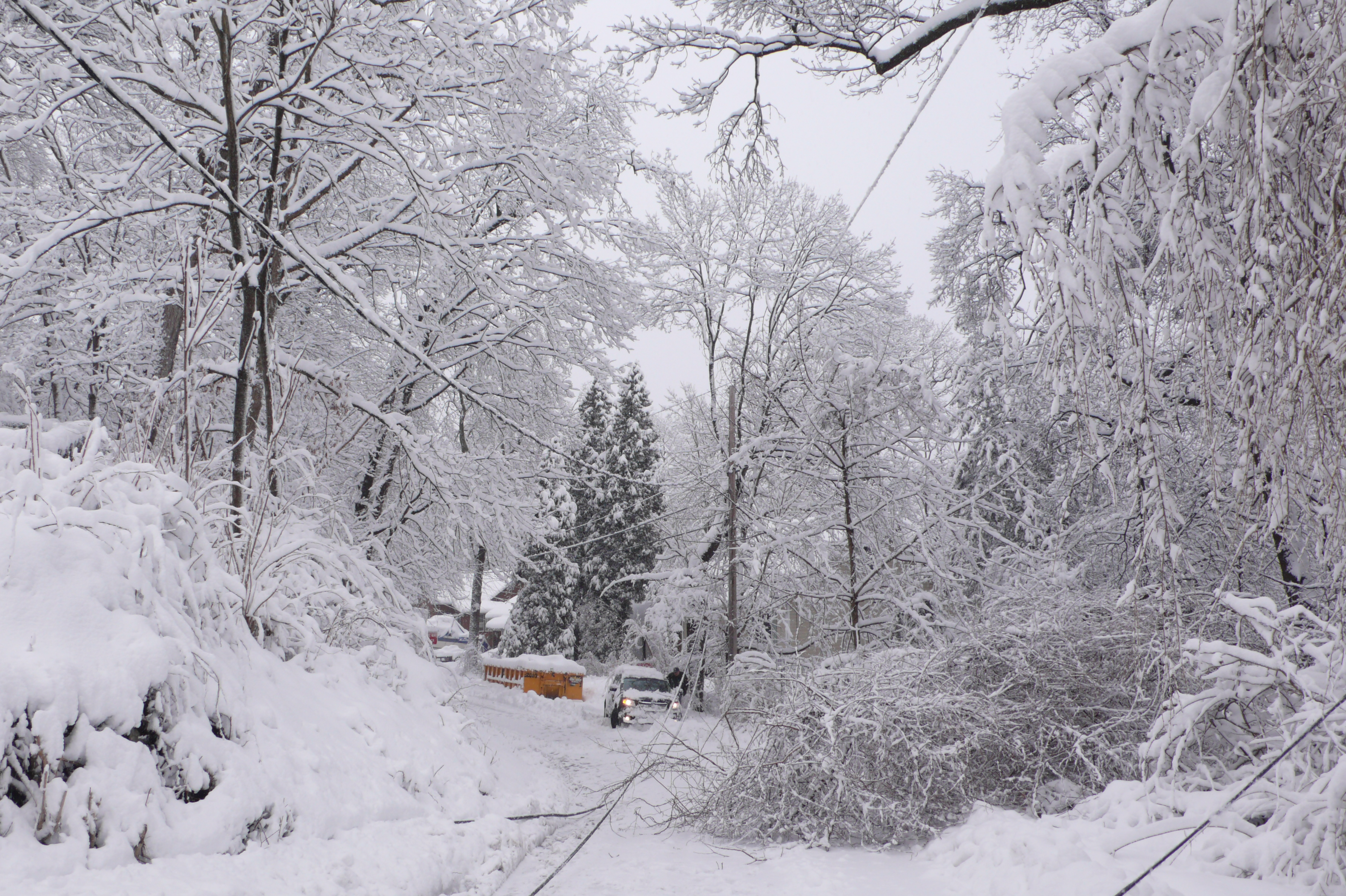
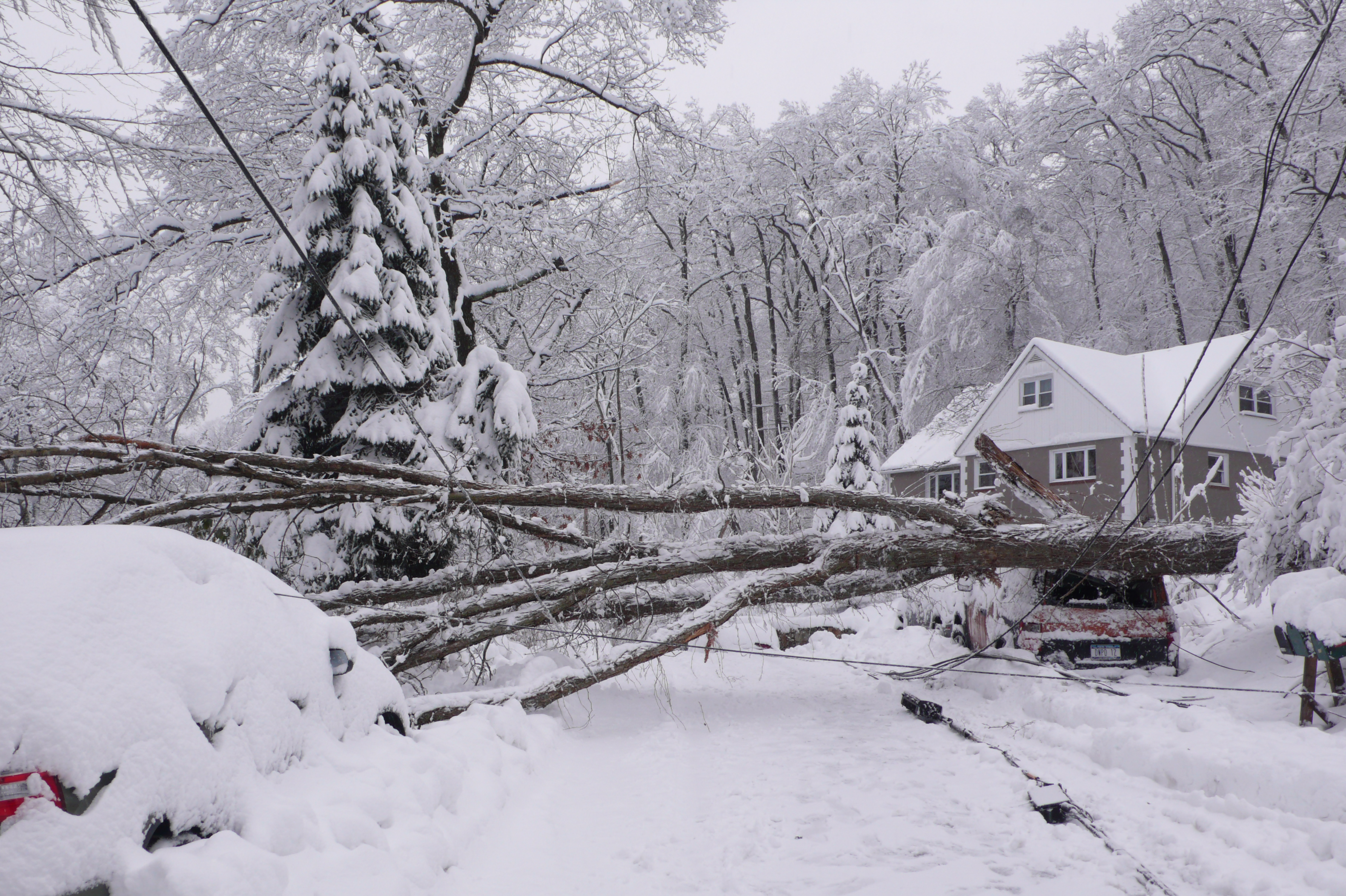
Exit “the Strunz” and return to that first winter. Long before a flake fell a strong wind blew down a power line and we rushed to get our generator running. Standing in the dark Jackson clutched a flashlight in the cold night air while I held the funnel in place and Rob sloshed in six gallons of gasoline.

“Shine the light here,” Rob shouted.

“Where? Here?”

“Just stand still.”

“Maybe we don’t need all that gas,” I suggested.

“Maybe you should shut up,” Rob barked as he tried to steady himself on an uneven walkway holding up six gallons of flammable liquid.

He finished and staggered back a little with the empty can.

“Can I go now?” Jack asked.

Rob grabbed the flashlight without answering and went to switch over the power. Jackson went back upstairs to play with his sister by candlelight.

“And don’t flush the toilet until I say it’s okay,” Rob called after him.

“Maybe we should just go out to eat or to the movies,” I said.

“Maybe you shouldn’t talk,” he said, nervously as he handed the light back to me. “Shine the light here while I set the choke.” Rob moved a small lever and stepped back ready to pull the crank. Which he did repeatedly until he had to sit down on a nearby lawn chair and catch his breath. I’m leaving out the string of curse words that filled in that span of time.

We regrouped and tried again and low and behold  the engine suggested it might start the way an old lawnmower sounds when it wants to help you out one last time. Encouraged, Rob took a deep breath, braced himself against the machine and pulled with every last article of strength he had left.

“F#*K!” Rob spat.

The little red generator roared. Rob beamed. He proudly turned on the alternate power circuit breaker and low and behold we had a smattering of lights come on in the house including the refrigerator and well pump. We were back in business.

Quinn came to the top of the basement steps and cried, “What’s that horrible noise?”

The sound sputtering from the generator was deafening but we had overlooked it in light of our recent success. We went inside and tried to shield ourselves from the din but it vibrated up through the walls and could not be ignored. Again I suggested we head out to the movies which was again rebuffed.

“We can’t leave the house with a running generator.”

And I hummed, “…we are all just prisoners here, of our own device.”
Image

©Robert Forlini

Jackson cupped his hands around the kitchen window and declared that all the houses across the lake had lights on. Either everyone had a generator or the regular power had been restored. Rob looked deflated as he turned off the motor reversed his steps and switched back over to the main line. But nothing could take away the fact that he had been able to make it work when needed. The cursing returned as he tried to figure out how to drain the generator of the remaining six gallons.

In the thirteen years that followed the little red engine that usually couldn’t sometimes came through in a pinch. The process never changed, Rob cursed his way through each encounter but he and little red began to get to know one another a little better. Each time Rob begins to switch over the lines he mimics the previous owner’s wife. “…it’s so easy. I simply wheel it outside that door, plug it in and it starts right up.”

When Superstorm Sandy hit last fall we had been prepared with a row of filled gas cans, gallons of drinking water, candles, lanterns, batteries, dry firewood and plenty of food in the fridge. True we still have to shout to be heard and Rob still curses but you can’t have it all. With life on the lake you sometimes find you get what you need.

Image

©Robert Forlini

SAMUEL T. CATT: RESIDENT

Image

A few years after we moved into our lake house a cat showed up. He sat on the front steps and stared into our living room window. It was only later that we realized it was providence.

“That’s Sweetie,” Rob said. “She lives across the street.”

The neighbors were selling their house and after they had loaded up a moving van and were about to depart we went running over.

“Wait! Don’t forget Sweetie,” we exclaimed, holding the cat under the front paws as the rear legs dangled down.

“That’s not Sweetie,” the neighbor said, lifting up a different cat before our eyes. “This is Sweetie.”

Perplexed we dropped the cat and asked, “Then whose cat is this one?”

“Yours,” she said, as the van drove out of sight.

We walked back across the street and cat that wasn’t Sweetie was already sitting outside our front door by the time we reached it.

“Well at least nobody fed the cat,” Rob said.

Our son Jackson looked upward and shrugged. “Does a little tuna count?”

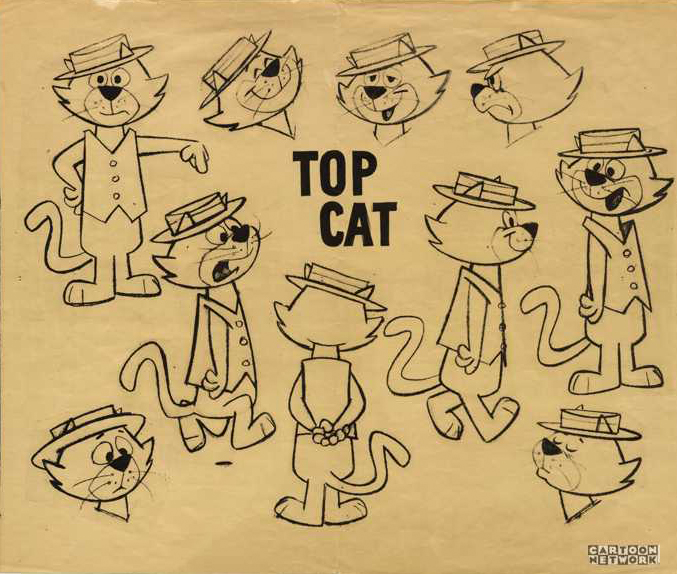
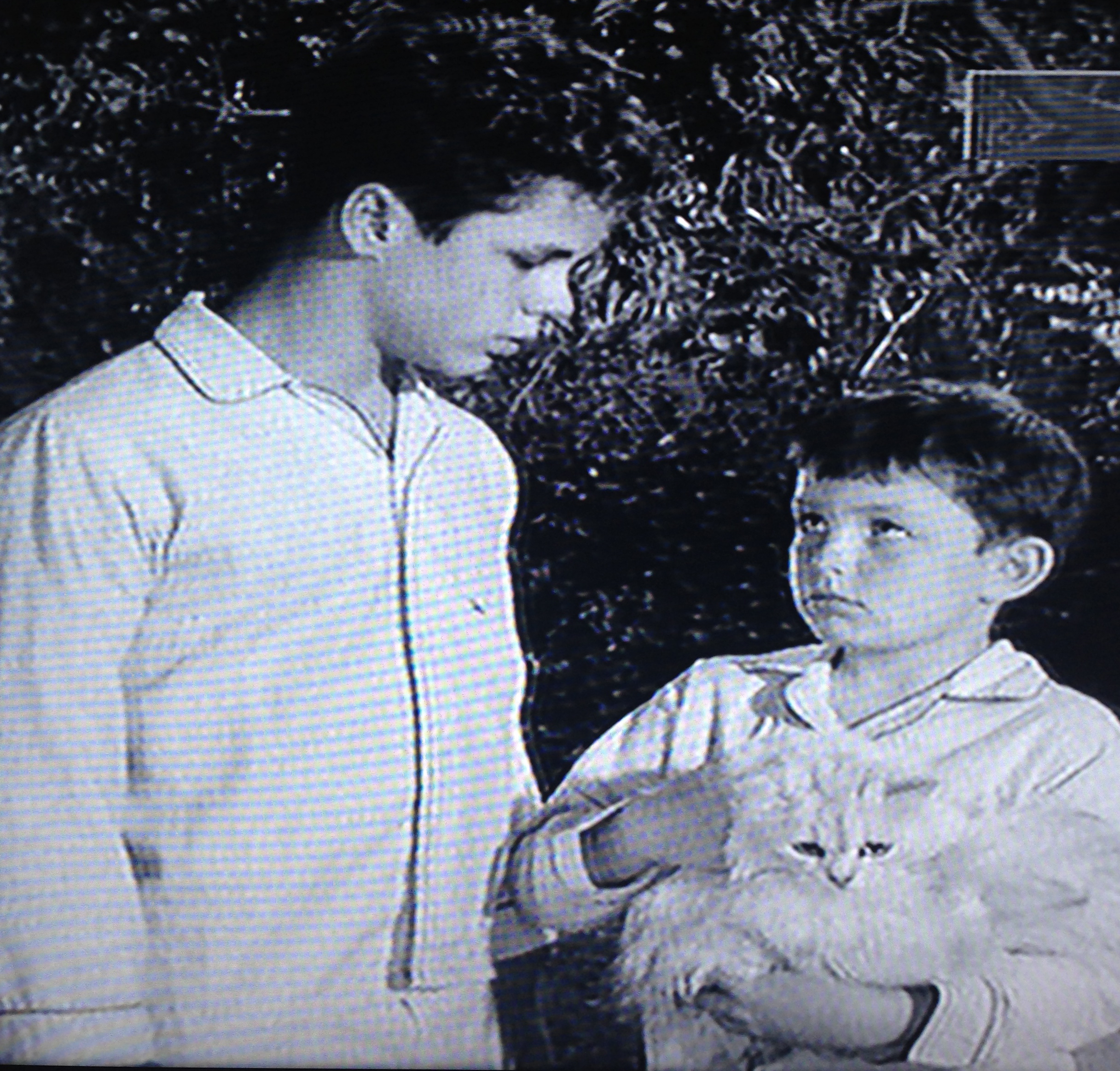
It felt like we were in the middle of a Leave it to Beaver episode.

Image

Cat out of the Bag

Our daughter Quinn told us the cat was named Sammy which was later changed to Samuel T. Catt: Resident.

“How do you know his name is Sammy?” I asked.

“He told me,” she said.

That was late summer and Rob began a battle of wits with the cat. It was clear that Sammy had no immediate plans to leave town. Each time the door opened he made a move to get inside and Rob pushed him back with his foot or a broom. The cat was undeterred. We started to trick the cat and run around the house to another door. He ran faster than us.

“No cat!” Rob yelled. “I’m allergic for God’s sake. We need to call the dog catcher.” He announced to anyone who would listen.

“It’s a cat.”

“Dog catchers catch cats.”

In truth they don’t. You have to call Just Strays and then they show up and catch the cat, spay them and then return them back to you. They don’t want them. Their mission is to reduce the population of feral cats. Additionally they ask you for a donation to cover the costs. Sammy wasn’t feral, he had a collar, seemed to like people and had a tattoo inside his left ear. When we researched the tattoo number with the cat registry it came up blank. His previous owners couldn’t have been too bright, they tortured the cat with a tattoo and then didn’t bother to list his number.

“Maybe he ran away from his owners because he’s still mad about the tattoo.” I suggested.

Rob took Sam’s photograph and we posted ‘Found Cat’ signs around town but nobody called. When we sat on the deck he sat with us. When we went to get the mail he went too. When we walked down to the dock he came along and watched us swim. When we pulled into the driveway he was sitting on the stone wall, waiting.

Finally it was decided that Sammy would be our outdoor pet and we took him to the vet and bought a plastic cat house for him to winter in. I laid towels down on the floor of the hut and put a water dish inside. Sammy never considered the hut but sat on the opposite side of the glass sliding door and stared into the kitchen and watched us. Even in the rain Sammy waited. He had a sad pathetic look that made the kids and I melt. This was sort of remarkable considering that I have never liked cats. Rob’s sister had five outdoor cats at one time and there’s a classic image Rob snapped of his father teaching us how to handle cats. I should have felt sorry for them but I didn’t. Sammy seemed different. When the temperature dropped I convinced Rob to let Sammy move into the basement.

“I wash my hands of this,” Rob shouted. “This is all on you and it better only be the basement.” The basement rule lasted one day before Sammy had the run of the first floor.

“That cat is not allowed in the bedrooms!” Rob shrieked.

“I agree,” I said and informed Jack and Quinn of the cat house rules. Cat house rules was an apt term for a cat that ruled the house. He spent parts of each day inside the kid’s bedrooms.

“If that cat so much as puts one paw on the stairs up to our room I cannot be held responsible for my actions,” Rob proclaimed.

“Noted,” I said.

Of course you know the rest of the story. Samuel T. Catt not only went up to the second floor but liked Rob best of all because he slept on his chest. It was as if Sam knew just the person he needed to win over, he was that smart. Rob and Sammy entered into a mutual admiration society. Rob trolled shops  for cat trinkets that resembled Sammy from refrigerator magnets to door stoppers and bought numerous cat toys that entertained him for less than a day. Because Sam still spent long portions of each day outside, Rob installed a cat door that only Sam could open with a magnetic key that hung from his neck so he was never left out in the cold again even when we were on vacation. Sam reciprocated by bringing in an assortment of small animals dead and alive as gifts. Rob had the job of removing all the animals as the rest of us ran to high ground screaming. He gave us a snake, numerous mice, birds that played dead and then came to life as Rob went to pick them up and they started to fly. One morning on my way to work Rob called me panicked.

“I can’t leave! Sammy brought a chipmunk in and its running around the living room.”

“Chipmunks are so cute,” I said thoughtlessly on the other end of the line.

“Not when their in the house!” he screamed.

Image

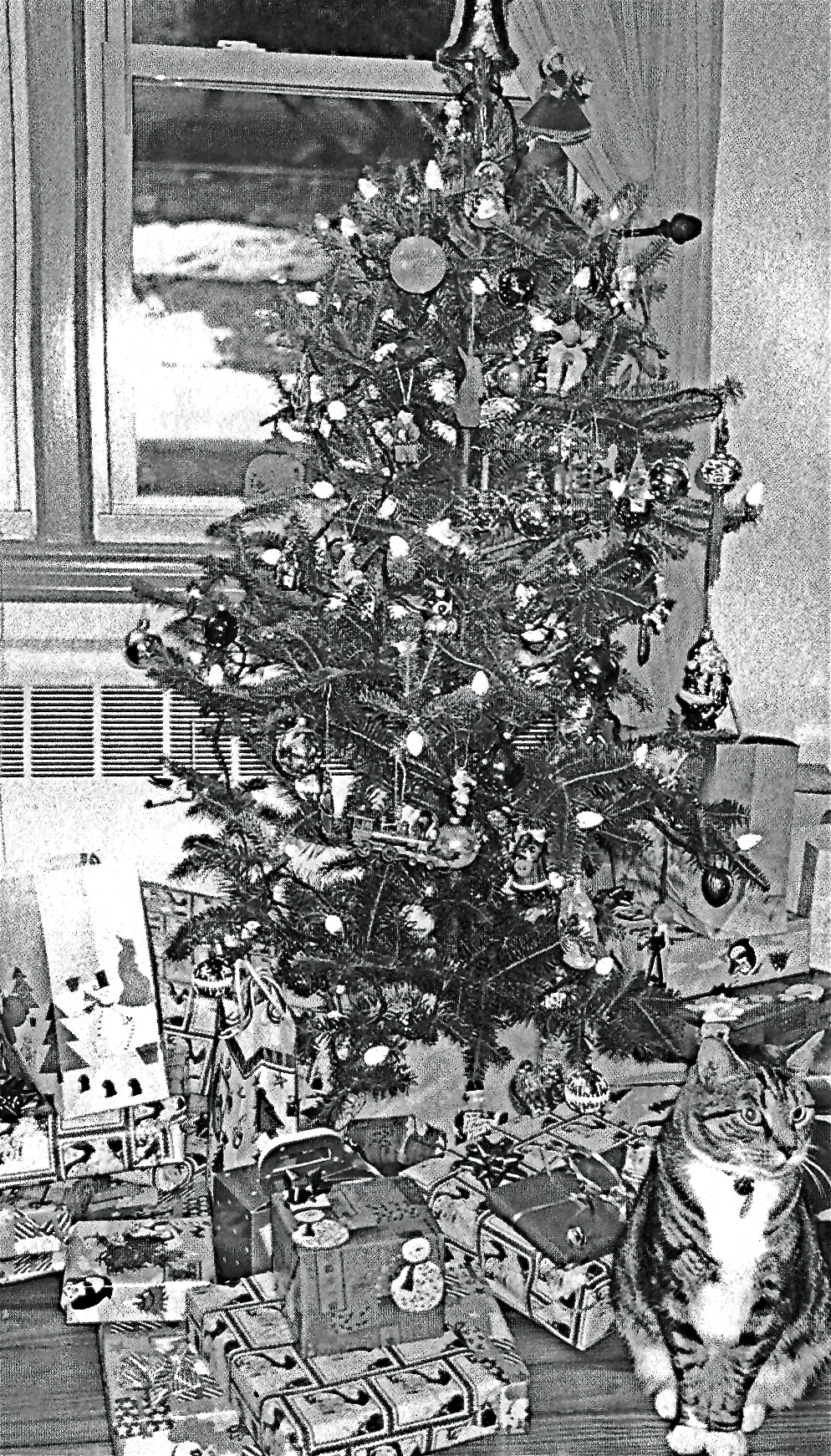
Sammy under the tree

After an hour long battle with the chipmunk Rob took the cat’s key away. It felt a lot like grounding a teenage child from driving the family car. Sam could let himself out but not in. We forced him to sit outside the kitchen door and wait to be let inside, always checking to be sure he wasn’t bearing gifts. If we knew it was going to rain we called his name and he came running. The benefit of having an outdoor cat was he didn’t use a litter pan and the house didn’t smell. One of the downsides was the dangers he encountered. He started to cost a lot of money as the vet tried to clear up one scrape after another. Towards the end he couldn’t fend off whatever animal was out to get him. Eventually the vet wanted to amputate his leg but offered no guarantee of survival and cautioned us.

“Of course if you opt to do this and he lives, he’ll have to stay inside the house forever.”

The idea of confining him to a 1500 square foot home with three legs was more than any of us could bear. Sam was in agony. I was away and Rob called to give me the prognosis before he and the kids went into the animal hospital to say good-bye.

“There just wasn’t enough time,” Rob wept.

A Perfectly Well-intentioned Person or November 22, 1963

Image

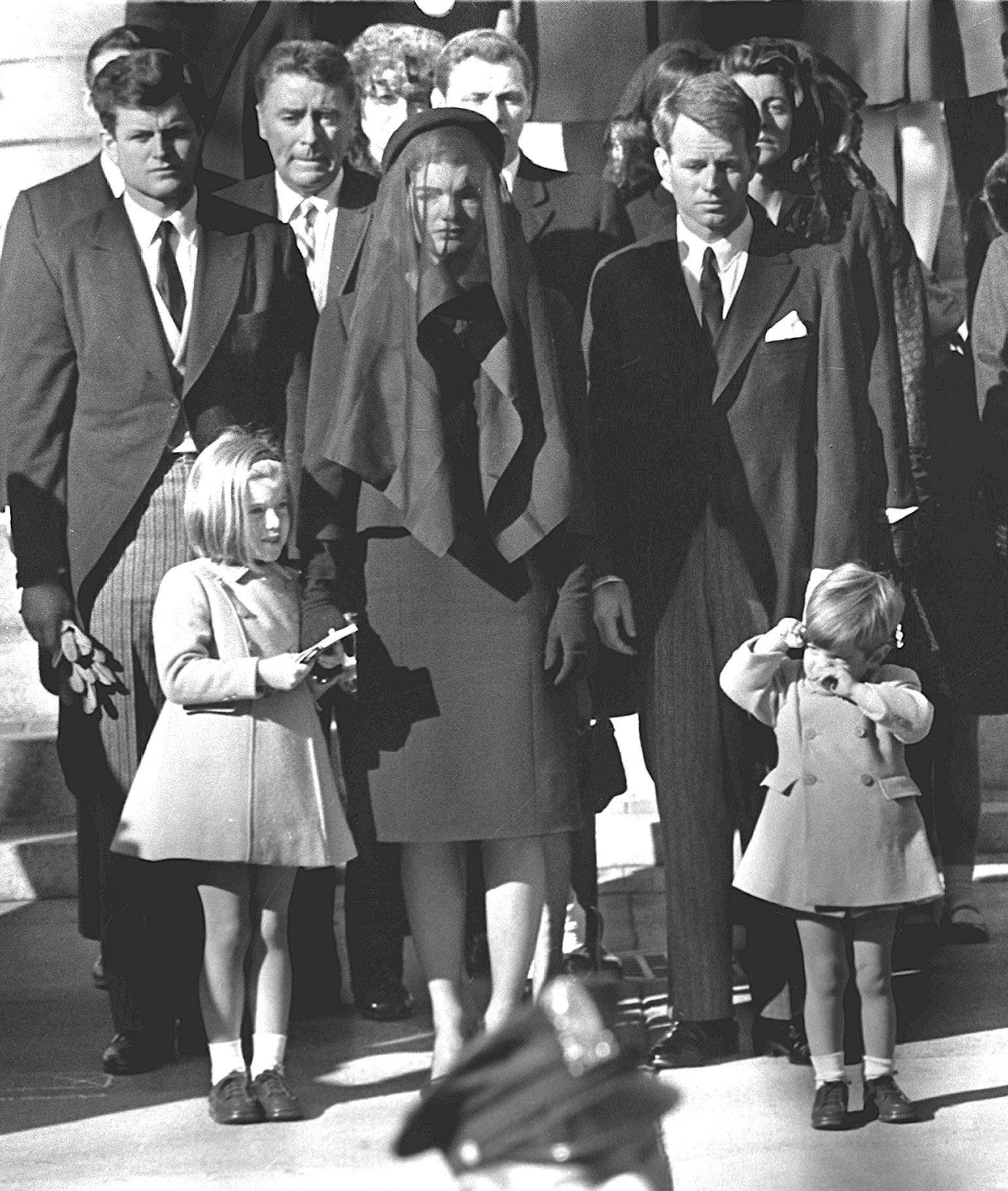
Last July in the newspaper I read: A perfectly well-intentioned person she has never met approaches her to say…almost anything that they believe is filled with heartfelt sincerity and the secret connection they share together. The “she” is Caroline Kennedy and I must confess that on the anniversary of her father’s death I would probably be one of those people if I ever got the chance.

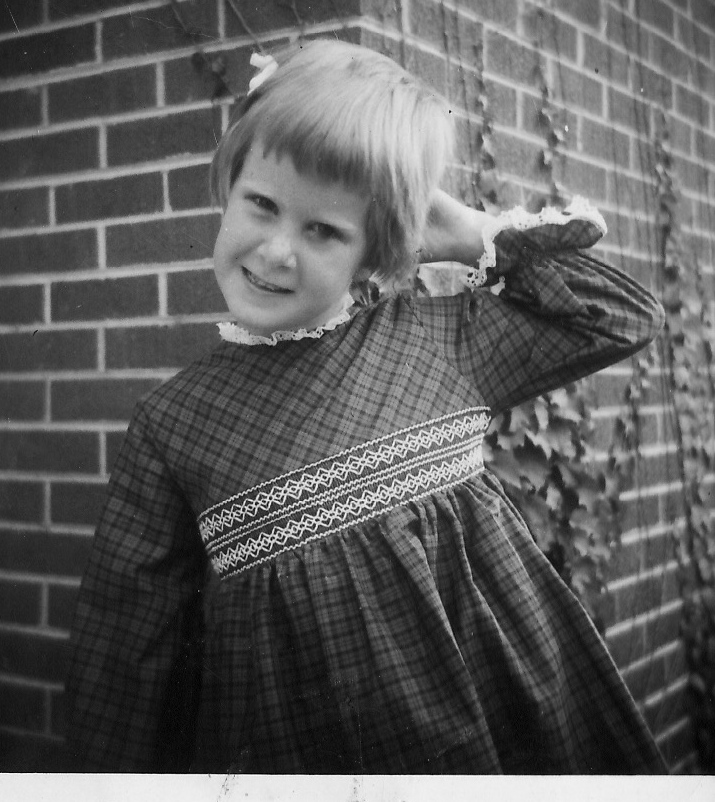
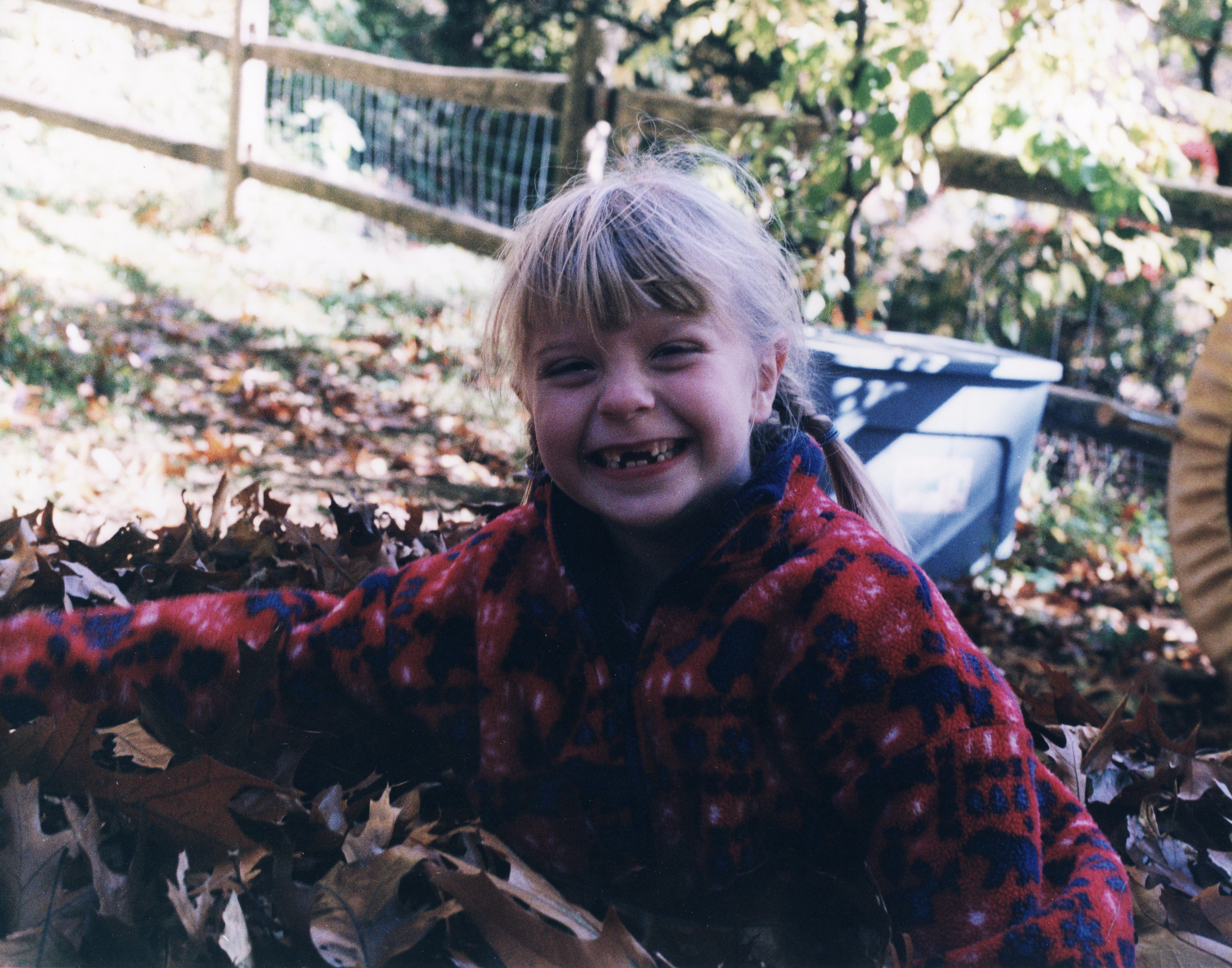
On November 22 , 1963 just after Kennedy was shot I boarded a school bus for the afternoon session of kindergarten with Mrs. Serfling. Life was relatively carefree. I don’t know if my mother knew he had been assassinated yet but by the time I returned home it was clear something was very wrong. I crept up to my parents’ bedroom and listened to my mother sobbing face down on her bed. My father was sitting in the car listening to the radio and didn’t roll down the window to speak with me when I knocked on the door.

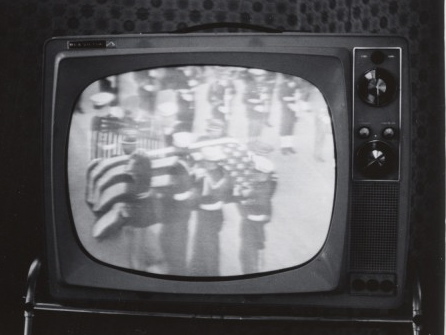
The days that followed were somber and quiet. I remember having the whole upstairs sections of the house to myself as my family sat before the large black and white television set in the basement and watched a slow moving story. The phone rang and I was surprised nobody went to answer it because we normally raced for the receiver, and being the youngest I usually lost. It was my father’s brother and he wanted to talk to my dad. I went downstairs and told my father who was on the phone but he didn’t say anything. I looked at the screen and saw the President’s two children in matching coats. I stared at the girl. She looked through the television set and I felt a connection to her. Then we watched some soldiers and I went back to the phone to say something to my uncle but the line had gone dead.Image

The next day in the newspaper Caroline Kennedy and her brother were on the front page. I pointed to her.

“How old is she?” I asked.

“Five.”

“Like me.”

“Yes.”

Look and Life magazines showed up and I combed the black and white pictures of the President and his family. One picture showed moving men packing up the president’s rocking chair.

“Why do they have to move?” I asked.

“Because there’s a new president now.”

That didn’t seem fair to me and I worried about where Caroline and her little brother would play now that they had to leave the White House.

Over the years I checked in with Caroline when she happened to be in the news. She had long thick light brown hair just like mine. We both graduated from college in May 1980, but her graduation made the paper.

She got married in the summer of 1986 just like me. Two of her three children are the same ages as mine and her son is named Jack and so is mine, and we’re both half Irish. After that the trail goes cold and I have no more dots to connect…she’s rich, ambassador to Japan, daughter of a U.S. president and owns a 375-acre estate on Martha’s Vineyard. I teach art and live on a fifty foot lot  and can’t afford to go to a restaurant again until my daughter graduates from college.

I don’t spend a lot of time thinking about her but when I come across a news story about her I read it. If I ever did meet her I’ve decided I wouldn’t be the perfectly well intentioned person that she forgets about seconds later because I would stay in the background, remembering when we secretly connected through the television set in 1963.

Image

Me in 1963

TWO YOUS OR SEE YEW LATER

Image

a normal yew

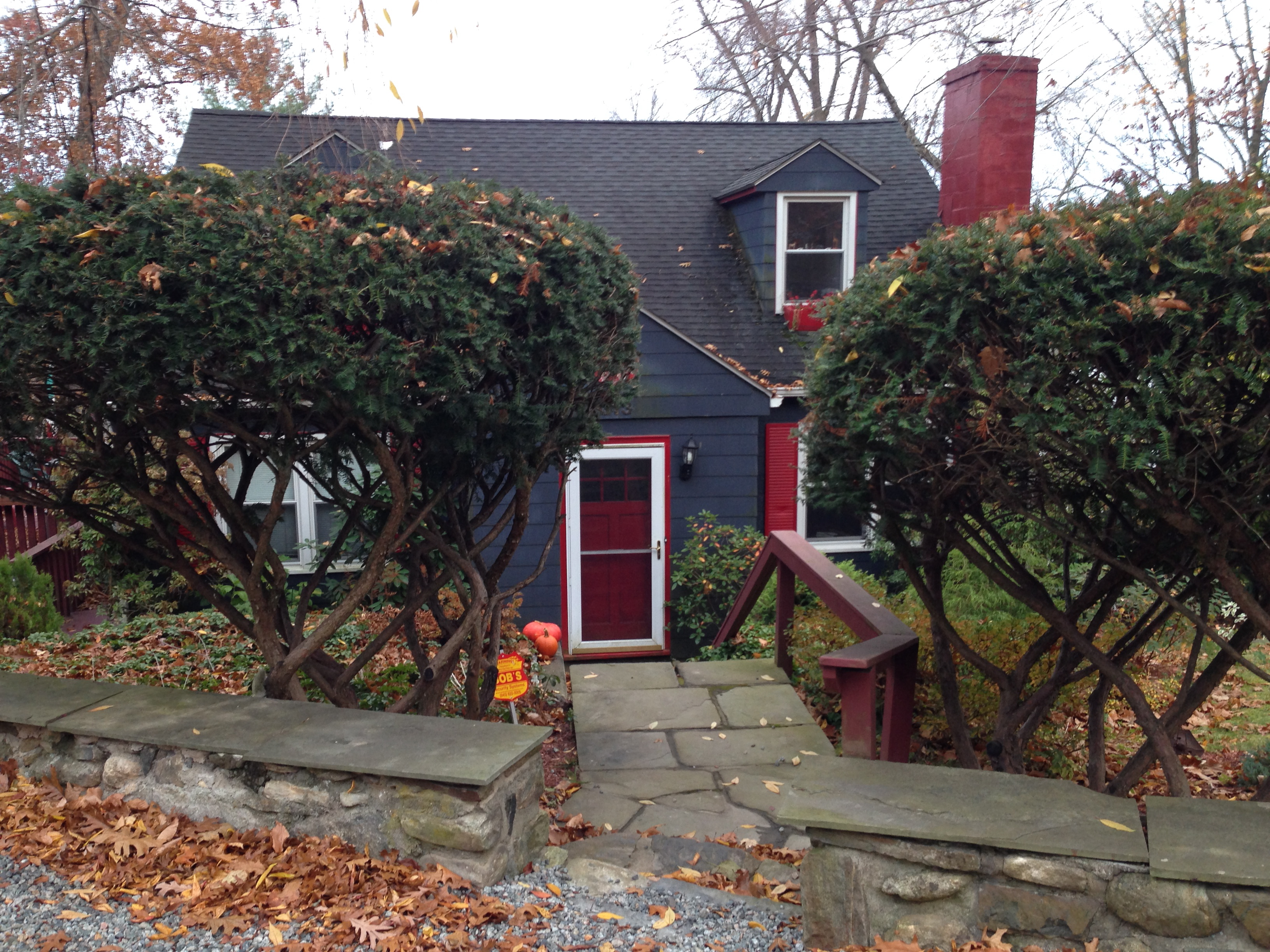
Our house is distinguished by two enormous bushes that sit at the top of the walkway leading into our front door. They resemble monster green mushrooms. The first time my mother came to visit she peered into the web of branches that held up their mushroom cap tops and said, “These are yews.” She stepped back and looked at them again. “Canadian yews. Very common actually but I’ve never seen any that looked like this.”

Image

The reason being is yews aren’t known for their height but rather their girth. One rarely sees the base branches unless they’re raking leaves out from underneath or trying to catch a hiding cat. Cats would never think to hide in our yews because of the exposure. Our yews stand close to nine feet high, spread out over six feet in diameter and have an almost sculptural trunk of intertwining branches that my daughter used to sit inside like a nest through elementary school. These two yews look more like props on a Star Trek set than bushes framing an exurban yard.

The two yews have two purposes; decoration, which they really aren’t unless we were vying to be an applicant in a Better Homes and Garden makeover or as camouflage.  The yews add a modicum of privacy but they also block out a nice view of our home. It seems covered up. These two purposes provide two perspectives; mine and Rob’s. These alternate points of view and have created a long lasting battle about the fate of these phantom bushes.  To cut them down or let them be.

Let’s be fair, the yews have gone rogue.  They’ve been growing on their own path without the supervision or care of an attentive homeowner for over thirty years and it’s too late to change their present course without an extreme intervention. The only care they receive now is an annual haircut that takes half a day and two people trying to reach the top while teetering on the edge of a step ladder sinking into the pachysandra.  We avoid this task until we can no longer walk down the steps without having branches scrape our faces. Spiders like to start in one yew and spin their web across the sidewalk to the other one. A trip to pick up the morning paper can result in spider web strands smeared across your face.

Image

Last summer during our annual trimming event we stopped random people walking past our house and polled them about the fate of the yews. The results shook down along gender lines. Women seemed to be instantly in favor of getting the chain saw out and men took a more studied approach. They either saw the work it would involve removing them or actually thought they looked “kinda cool,” which was the common response.

“What are you going to put there instead?” one neighbor asked.

“Uh, different bushes.”

“Not sure what that will look like.”

“Well it will look better than this, that’s for sure.”

“Nothings for sure.”

One person felt it was a bird habitat and they should stay put on those grounds alone.

“We have a lot of other trees for the birds,” I offered.

“Not the birds that like these trees,” they countered.

“They’re not trees! They’re bushes.”

“They look like trees.”

I stop asking people. After all it’s not up to them and if I lived here alone the bushes would have been toast a decade earlier. I change my tact and call a professional tree man.

“You’re gonna lose a lot of privacy.”

Rob agrees. “That’s what I think.”

“We can put in different bushes. Better bushes,” I say.

He clicks his tongue. “A normal yew has a huge root ball,” the tree man says. “I can only envision the size of these babies.” He shakes his head slowly which is code for money. The slower the shake the more it’s going to cost. “I never saw anything like them,” he says as he cranes his head back.

This much is clear. Removing them will not be easy and it certainly won’t be cheap and in the end it may not be much of an improvement. Sometimes the only way we can distinguish ourselves is by the one thing we have spent our whole lives trying to avoid. A lot of things in life are like that.

THE NEW YAR TIMES

Image

Katherine Hepburn’s character Tracy Lord, in The Philadelphia Story refers to a yacht saying, “my, she was yar.” Then she explains to her fiancé, George, what she’s talking about. It’s a telling moment. We learn that he’s not the man for her because he doesn’t know what yar means.  A majority of the audience for this 1940 movie needed to have it explained as well. It’s clear that most of America, like George, is moving with a different crowd than Tracy Lord. Lately I’ve been feeling like that with the New York Times.

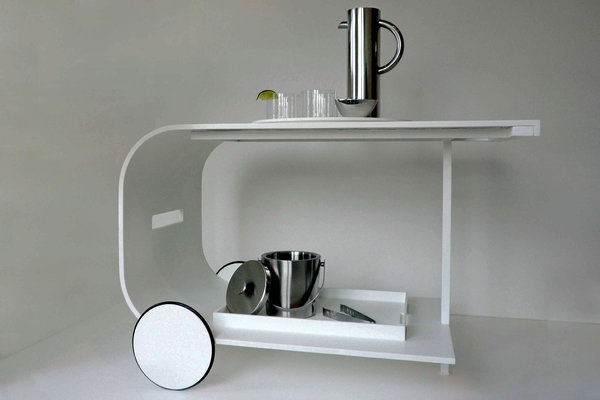
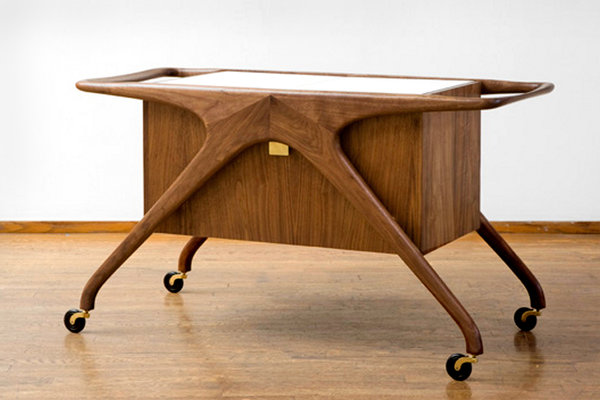
The paper gets delivered to our house at roughly five-thirty every morning. You can hear the driver’s car roar around the lake followed by a dull thud on the street as the paper hits the driveway and the engine roars off again. I find the sound comforting  as I press the snooze bar for the third time. It gives me another reason to get up. Rob has moved on to electronic venues so the physical paper is mine alone. Reading the paper from 6:15 to 6:30 every morning doesn’t give you a lot of time to delve too deeply.  Today I read about rolling bar carts.

 Image

My first thought was, “Who uses a rolling bar cart?” I imagined a house so expansive that the cart could have room to roll. I tried to picture the occasions that might call for a rolling bar cart.

         “Oh Robert, would you be so kind and roll in the bar cart and mix us all a cocktail.”

Would you use one for small gatherings as well as large? The article interviewed Alessandro Palazzi, the barman from Dukes Bar in London. “The style is very important, because it is used as a decoration or to show off your drink collection,” he said.

Image

Well that explains it. My bar doesn’t contain a collection that lasts longer than the length of a party and it’s usually contained on the card table I set up for the occasion. I mused about the possibility of buying a rolling cart as I started to scroll through the pictures displaying the range of styles available. That’s what the Home section is for, to help you imagine the possibility of owning something you had never thought of before like an exotic tree house or a radiator that’s made to look like a ram for only $11,000.

The bar carts were priced from $300.00 which seemed a bit high but low enough so I could still be a player, and went up to $17,500.00. Most were in the several thousand dollar range. I felt like George in The Philadelphia Story.

I thought about the driver who has to get up at 4 AM to get all the papers in our area delivered on time. Every Christmas we send twenty-dollars to our carrier to ensure this great service.  It seems like a tough job. Last year we had a terrible delivery person and the paper didn’t show up consistently until close to nine in the morning. We were on the phone with the Times every day until they resolved the problem. They never disputed our claim and sent the complaint up to the head office. Boy was I impressed, the New York Times really wanted me us as a customer.

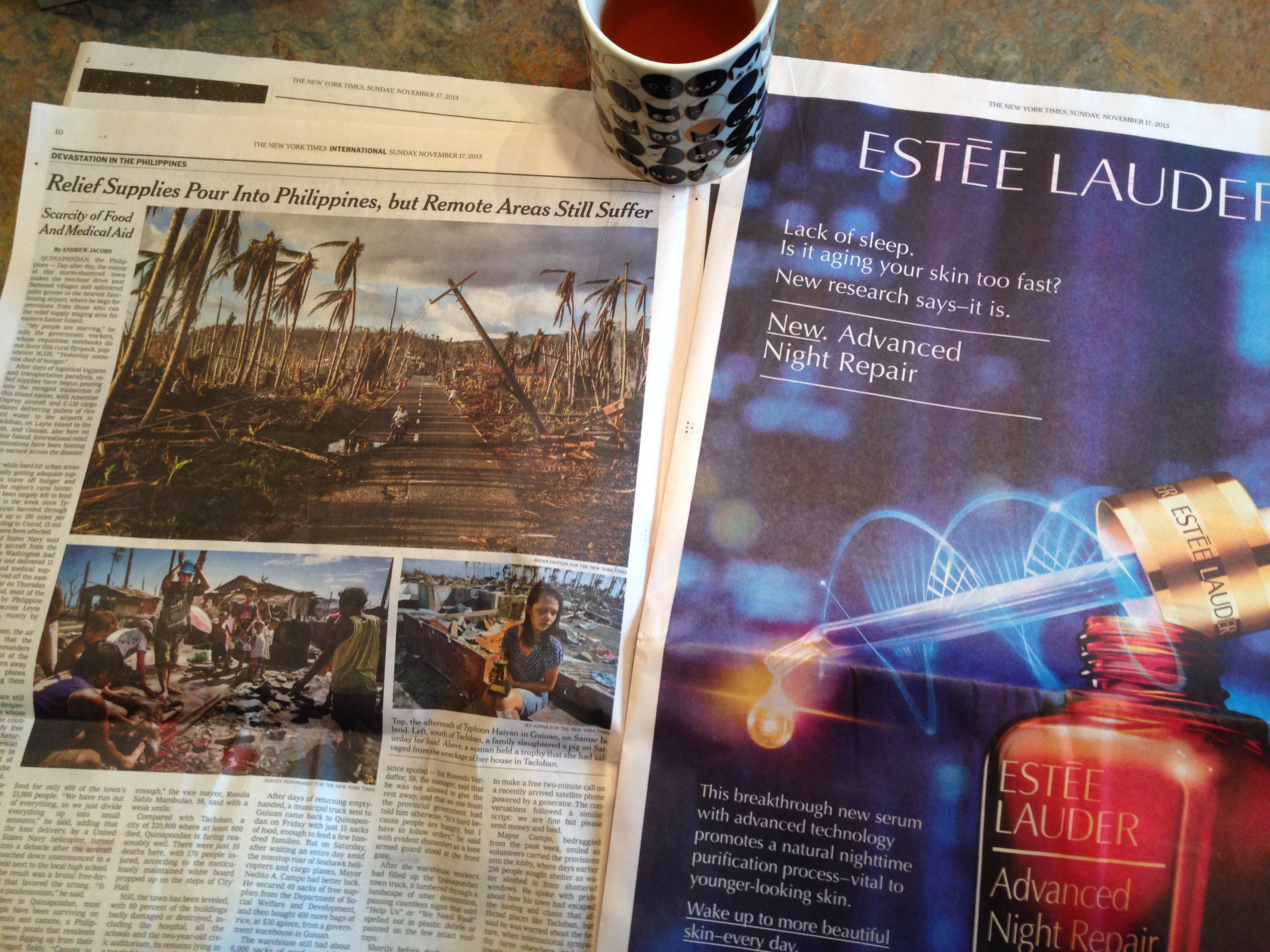
But I often can’t imagine why. I always knew the ads were for the One Percent but I think I blocked out the fact that so are the houses, wine, clothes, most restaurant reviews and the vacations they write about. And it seems to be getting worse. I also noticed that full page ads for Tiffany’s, Bonwit Teller or Bloomingdale’s are juxtaposed to  stories about impoverished nations but never next to national or local news. I feel the ad placement is deliberate because expensive items next to the Neediest Cases might be a “tough sell.” Rob thinks the companies just want ads in the first ten pages of the paper and that happens to be the international section.

.Image

On Sunday the second part of the weekend paper arrives. I open up the main section and snap a picture. I make my way through this section and test my ad theory. Then I move along to the Sunday Review where the only ads are for education jobs. I land on an editorial called “Sentenced to a Slow Death.” It begins with, “If this were happening in any other country, Americans would be aghast…” I read about the needless life sentences of non-violent offenders that is costing $1.78 billion dollars for the lives of their collective incarcerations. This is why I read my local paper. The news is for everyone. We have to gerrymander through it to find what we’re interested in.

That doesn’t mean I can’t imagine inching a bar cart around my small lake house and saying, “My, isn’t she yar?” and hope someone is listening.

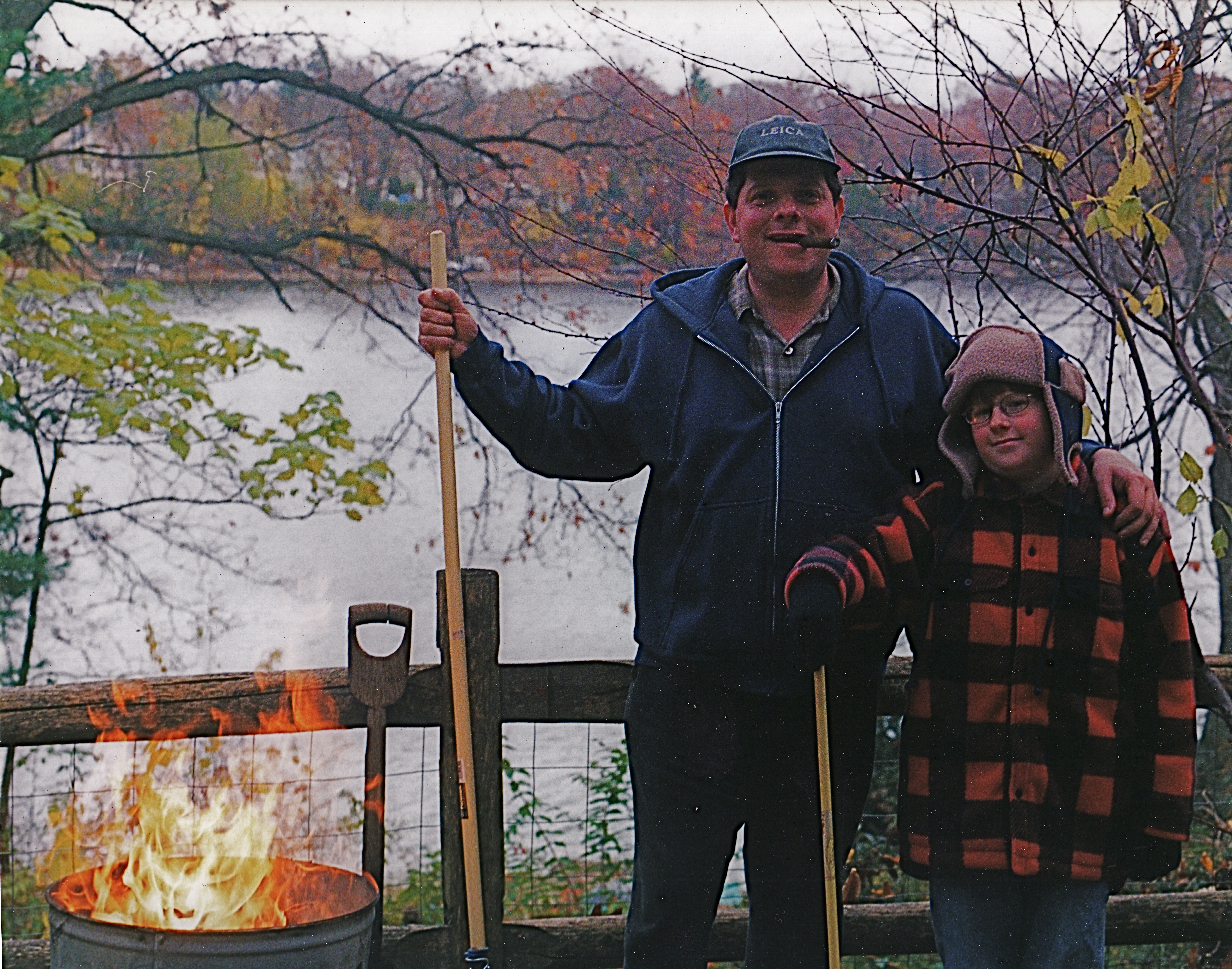
MOLOTOV COCKTAIL MIXED WITH LEAVES or LEAF BOMB

Image

In 2000 we moved from an apartment with no lawn responsibilities to our current lake house with a naïve perception of what lawn care entailed. The house sits one hundred and fifty feet above the lake at a steady incline. So steady that if you walk up to the house from the dock you’re out of breath.  In a previous post, Satan Zero Us One, I wrote about the challenges of mowing this lawn but all of that pales in comparison to leaf season. Just after the spring flowers pass and the trees are ripe with bright green leaves I pause and remind myself that this is the longest point in time when we can enjoy the benefit of the leafy trees and not have to think about raking. Leaf raking season lasts from the middle of October until the first week in December and no matter how much you rake and bag more leaves always seem to fall. One year we completed our leaf work on Christmas Eve.

That first autumn, the task began brightly as we piled into the station wagon and headed down to our then local hardware store to buy rakes.

“Oh, they’re so cute,” I cooed as I plopped two shrub rakes down next to the regular size rakes. I imagined our two young children heartily joining in the chore.

Ready to pay, Rob lifted a galvanized garbage can patterned with holes onto the counter.

“What is that?” I asked.

“Leaf burner,” the gruff hardware lady said, in a matter of fact tone that didn’t illicit any more comments from me. “Don’t forget to get a permit,” she added.

Dear reader, I know what you’re thinking. Leaf burning? Isn’t that illegal? Most places yes, but in lawless Putnam County it was legal and encouraged. Having a permit meant that we simply called the local sheriff and informed him we were commencing with a leaf burn and then called him back again when we had completed the task. I’m not sure what the phone call did to protect the town from a raging wildfire.

Rob’s idea was to rake all the leaves into the burn can, throw in a match or two and sit back while the fire did all the work.  This plan lacked some basic considerations. All the leaves still had to be raked into a central location to be close enough to pile into the burner which was the same amount of raking it would take if we stuffed all the leaves into paper leaf bags.  The only time saver was hauling the bags up to the curb. Our burn can was only twenty-five gallons which was equivalent to less than one packed paper leaf bag.

Image

The shrub rakes became swords until one was lost under a pile of leaves my seven-year-old daughter spent the day playing in. Our son Jackson raked just enough to stick around and watch the miracle of leaf burning.  It was a concept he had never thought about until that morning. Which meant I raked masses of leaves down hill to the burn site while Rob supervised the entire burn operation. The way he saw it, he would start burning leaves as fast as they arrived. After we had accumulated an enormous pile, but really a fraction of the sum total, the three of us peered into the can with holes.

“Why aren’t they burning?” Jackson asked.

Rob had already worked his way through half a box of large kitchen matches. “I need a stick so I can stir them. They need air.”

“Isn’t that what the holes are for?” I said.

“Don’t talk. Just find a stick, a long stick.”

Whenever Rob says, “Don’t talk,” you can be pretty sure he doesn’t have a clue about what he’s doing. Nevertheless a stick was procured and Rob stirred and stirred his smoldering cauldron as he continued to drop in lit matches.

“Maybe we need newspaper to get it going.” I suggested.

“I’m not even going to point out how idiotic that sounds.”

“You just did.”

Eventually he ditched the stick in favor of a shovel and started to turn the leaves over. After about an hour of this method the only fire he managed to generate was a few singed leaves and a heavy aroma of smoke on his clothes. At this point Rob declared it was time to really get this leaf burning going “Mario” style. Mario was Rob’s father, who believed that a little gasoline or naphtha could cure just about any predicament, including lighting a household barbeque or killing weeds. Rob went to fetch the gas can. “Now stand back,” he warned as he poured in a splash of gas. We all took one baby step back. He folded the mixture up with his shovel and tossed in a lit match.

What happened next is the stuff legends are made of. The instant the lit match hit the inside of the can a homegrown mushroom cloud explosion erupted upward about ten yards, knocking the four of us off our feet and onto our rear ends. The sound was so deafening it caused our ears to ring and it was several seconds before we even knew what had happened in order to react to the now blazing fire streaming out from the top of the burn can and out through each hole. Rob shook himself off, jumped to his feet and began to control the blaze with the small garden shovel. You could tell he had been raised to think fast in the event of a self-made disaster. Mario would have been proud.  In the end the gas did the trick and Rob and Jackson happily burned leaves until dinner.

Image

I know we’re lucky we all lived and the house didn’t burn down and it makes sense the county eventually outlawed the practice in 2010 but I look at this picture and I can’t help but feel nostalgic for that day.

The following year we purchased a leaf blower. The things we give up in the name of progress.

LEAVE THEM WANTING MORE

I haven’t been back to visit my father’s grave in Illinois since his funeral in 2007, so my sister’s e-mail containing an image of the stone was a welcomed sight. It’s a simple marker, slightly elevated from the grass containing his name and dates, the Janus logo and this line– Leave them wanting more. It’s a great line, especially for my father, who knew when to end a story, an argument, an advertisement or a eulogy. His strength lay in his often keen ability to self edit, whether written or spoken.

Image

Leave them wanting more can be applied to so many things in this time of excess and heightened self importance. Leave them wanting more, not taking more. Wanting and taking are polar opposites.

A lot of people today are clamoring for their own personal version of celebrity. They drop in at the local diner and share ten pictures of the event. They believe everybody who knows them needs to have this information.

“Heading off to an overdue appointment at the nail salon.”

“Why can’t we have ‘nut-free’ and ‘contains nuts’ tables at the school bake sale?”

“Just about to eat this monster donut!”

Not only do I not yearn for more, but find myself running from what is offered. I want to share in the lives of my friends and family, but mainly key events.

Image

My father’s memorial is the only connection I have to a now much altered community. When I was a small child, the town and surrounding area was awash in flat, black Illinois farm soil and patches of forgotten prairie pushed up against the encroaching but still distant suburban sprawl. The main street was quaint and two-bit with Swiss chalet store fronts and an old mansion serving as the library. The local diner had a twenty foot milk bottle sitting on the roof that said, “Joe’s.” But before I was out of middle school a large percentage of that rich soil was sold, paved and turned into auto dealerships.

Image


The town currently boasts having thirteen extremely large, new car lots. The town website proudly declares, “In Libertyville buying a car has never been easier!” At what price? And of course the milk bottle is gone for better or worse. Libertyville, where my father is buried, has never left anything alone which might explain how it became a wealthy upscale village that young professional families clamor to today. The town motto: Fortitudine Vincimus

“By endurance we conquer” says it all. They don’t want more because they took it all. I understand this is not particular to Libertyville. Most small communities that rest within commuting distance of a major metropolis strive for this achievement.

Except where I live. Noting the subheading of this blog, Navigating the world from a small lake near New York City, this is surprising.

When we moved here over thirteen years ago the business district was a sleepy, ramshackle collection of quaint, small businesses.  We had a decent hardware store, salons, a pharmacy, wine shop, auto repair, pet supply store, two post offices, a decent deli, pizza parlor and a number of professional offices. Today we consist of a biker bar, two nail salons, tanning salon, a bagel shop, a beading den, pharmacy and a liquor store that is struggling to the point of absurdity. Most of the businesses are stuffed into a large out of place blue office building that never should have been built. There’s a fine line between rural bliss and rural blight and we’ve reached it.Image


Libertyville destroyed it’s rural character by paving over the richest farm land in the world to make more parking spots. My town has retained it’s rural character but at the same time driven out most small businesses and left vacant, rotting storefronts that glare at visitors just on the other side of the town’s welcome sign. This is not the outcome of a bad economy but bad planning. Our lack of development has left us wanting more. Not always a good thing. Like everything in life we need a balance. Our town motto is Putnam Valley: The Jewel of Putnam County, which I really think they should reconsider. Too bad my Dad isn’t around to write a more appropriate one.

Image

PUMPKIN LOVE

Image

Despite the fact that my children are grown, I still rush out to buy my pumpkins each Halloween. Rob and I rummage through the piles until we find our perfect one. We each eye the other’s choice with a mild slice of pity, as if to say, “Too bad you didn’t get the one I found.”

Everyone loves pumpkins, even the hooligans who sneak into your yard under the cover of darkness and smash your jack-o-lanterns. I’m sure they would never smash their own pumpkins. People can’t help falling in love with pumpkins. Pumpkins are the vegetable with personality. So much personality that we carve and paint faces into them in an attempt to bring out their true identity.

Growing up in a flat northern Illinois landscape, one of my favorite memories was our annual trip to a small farm less than a quarter mile from our suburban home. The pumpkins had already been harvested and were spread out in size order ranging from 5 cents for the smallest, up to two dollars for the largest. I usually picked out one that cost a dime. It was easy to carry and I could tell it loved me back.

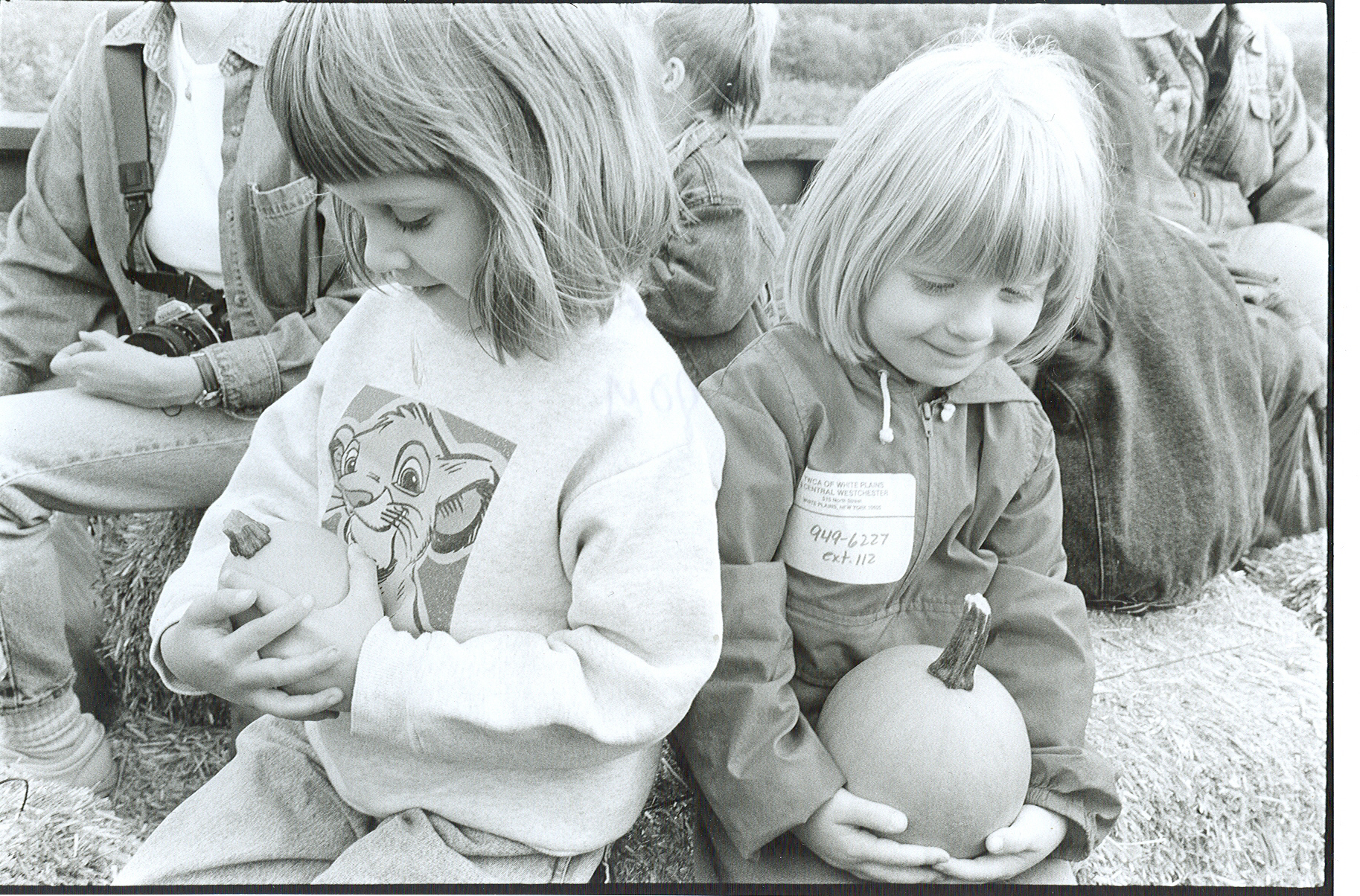
Thirty-five years later, when my own daughter traveled to a pumpkin patch on a school trip, I recognized the instant bond she and her friend had made with their personal selection. I asked my daughter why she had picked out that particular pumpkin.

“Because this is my baby,” she answered as she kissed it.

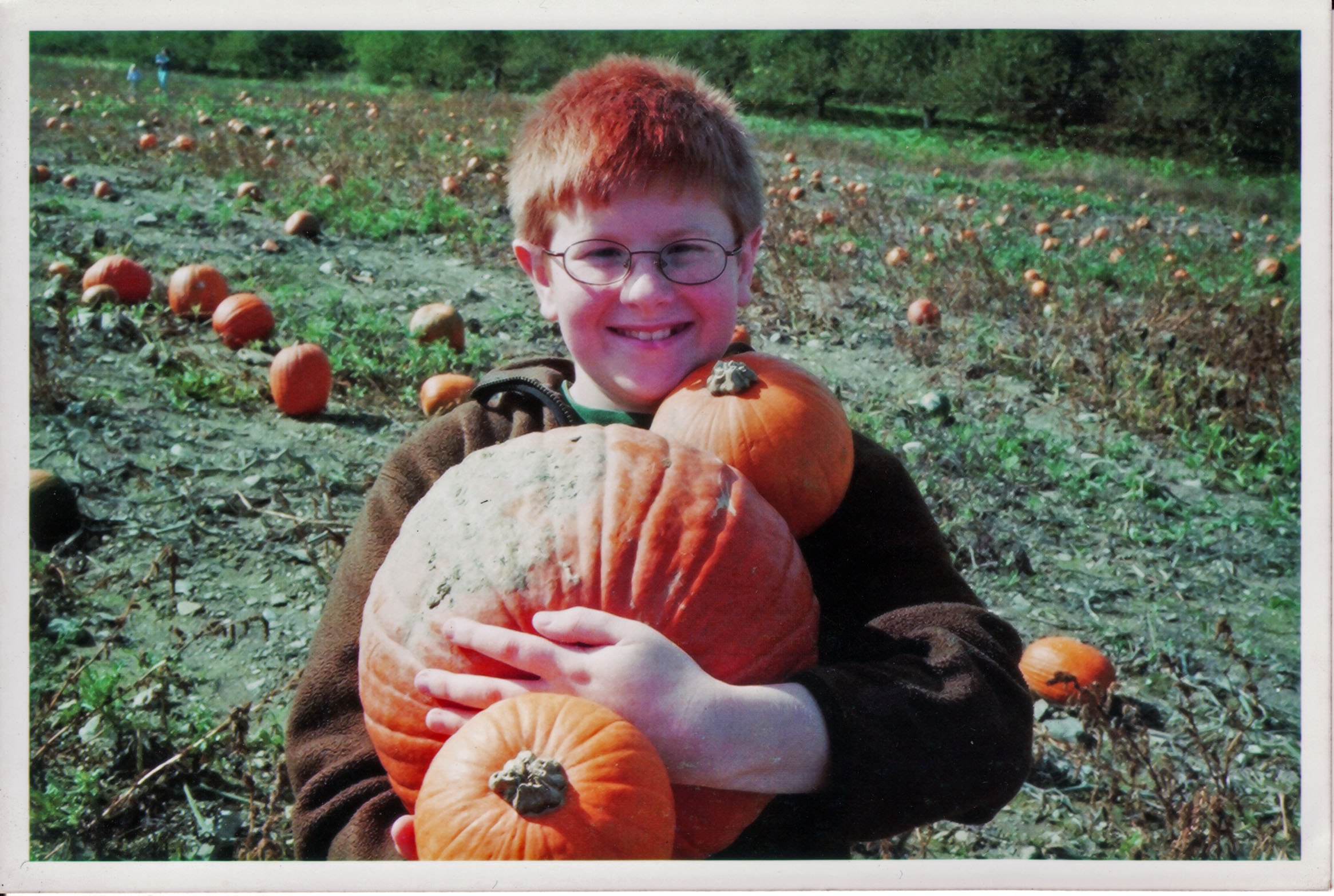
As a young boy, my son had pumpkin red hair and spent his childhood quests for the perfect pumpkin camouflaged among his choices. Here was proof that we had pumpkin in our genes.Image

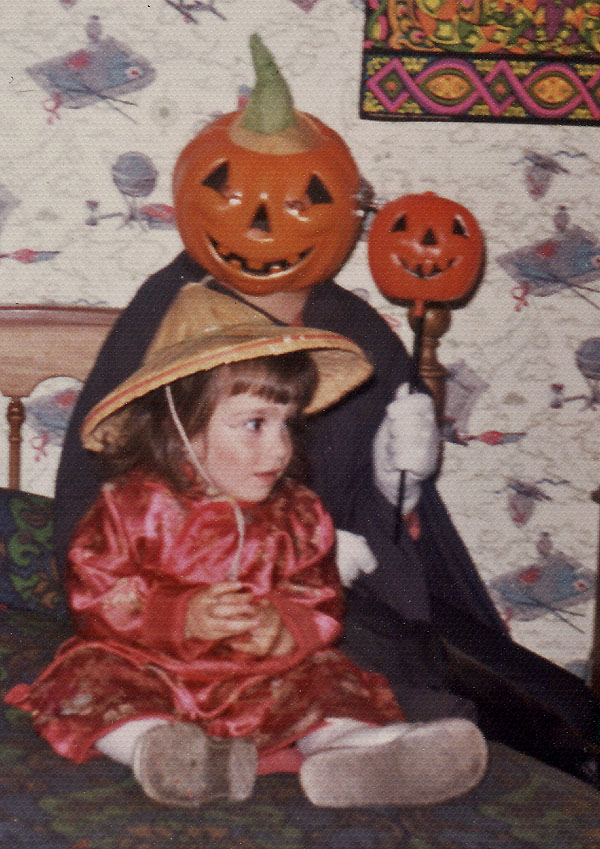
Rob’s affinity for pumpkins ran so deep he decided to impersonate one when he was a child and spent the better part of one Halloween with his head crammed into a plastic pumpkin shell. When I first saw this photograph I thought, “I better marry this man.”

Image

The first year we were married we lived in Brooklyn and when October rolled around we set out in search of pumpkins. We found an old Italian woman selling pumpkins from her vegetable stand.

“How much?” I asked the vendor.

“What?” The lady squawked at me in a thick accent.

“How much are the pumpkins?” I tried again.

She rolled her eyes. “You tell me which ones you want,” she said sucking her teeth and inhaling, “and I tell you how much.”

“Uh, you tell us how much and I’ll tell you which one we want,” Rob said.

Needless to say we didn’t buy any from her. But I felt a little sad and guilty. Sort of like someone who goes to a pet shelter to adopt a cat but leaves empty-handed. Those pumpkins deserved better than her.

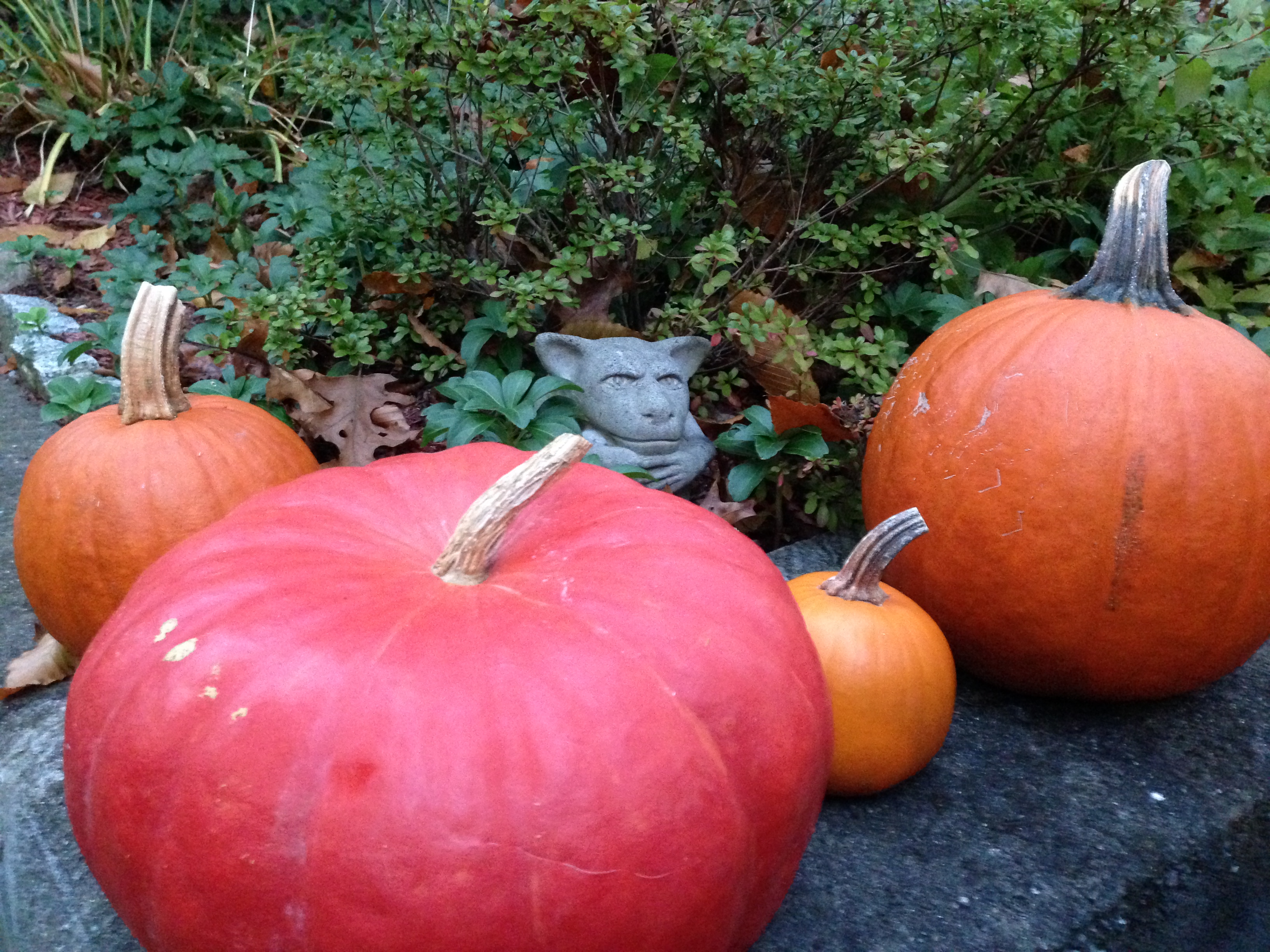
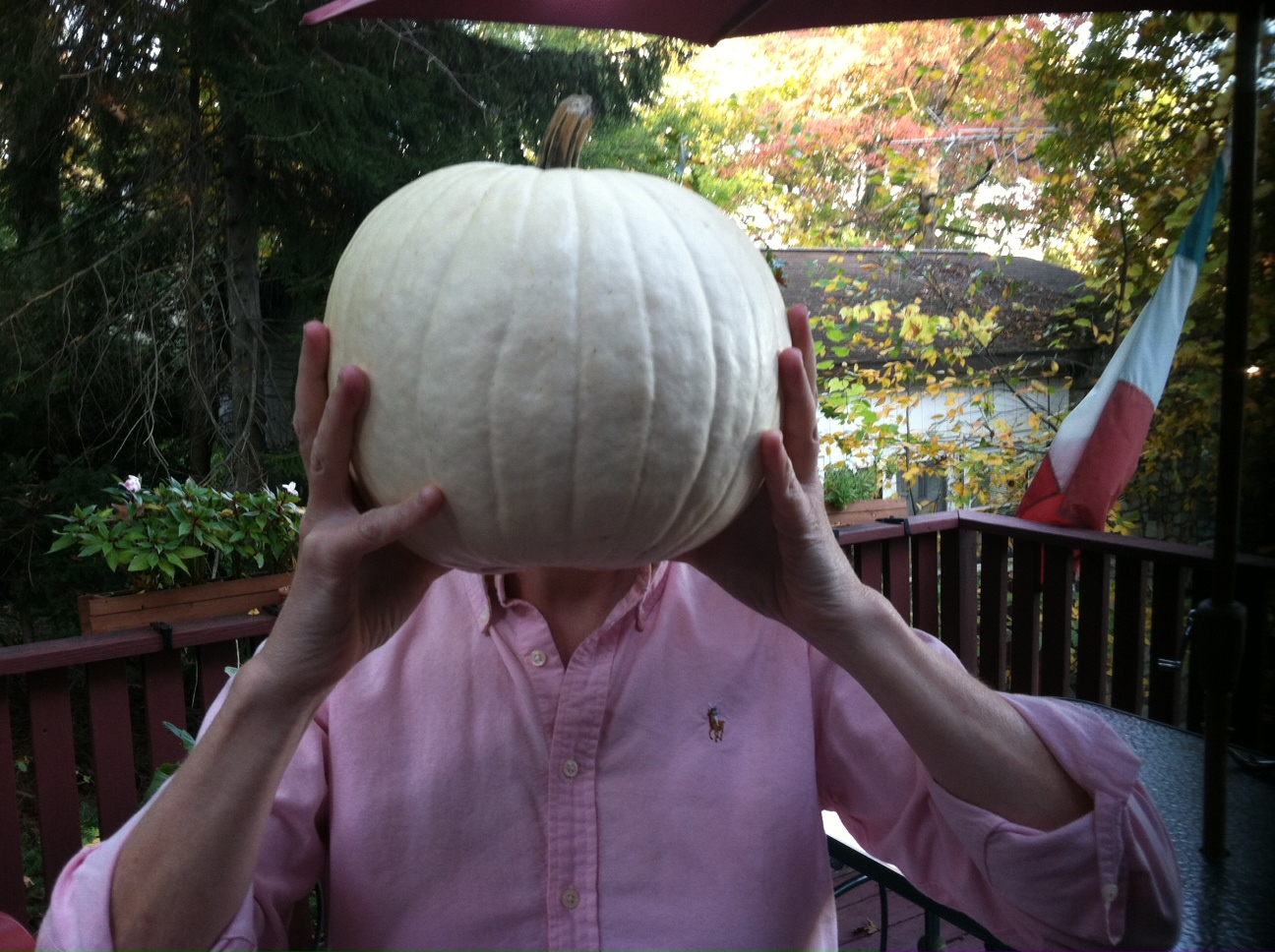
So far this year we’ve brought home five pumpkins. Three traditional orange pumpkins, a Cinderella pumpkin and a white one also known as a lunar pumpkin. The lunar pumpkin reminds me of a relative. He sits on the kitchen table and keeps me company at 6:15 in the morning as I drink my tea and read the newspaper. I keep thinking about putting him outside with the others but I can’t bear to part with him.Image

BROKEN REMINDERS

I have been waiting my whole life for my real life to begin. There is always a lingering distant opportunity of something better. Whenever I travel I see the latent possibilities of what life would be like if I only lived there. I see where I would shop, walk to yoga classes, drop off my dry cleaning and eat. I watch myself through the glass as a happy customer in the window seat enjoying a glass of Malbec with smiling friends. I am well dressed, I am thin, I am popular. I am famous. Then we go home.

It is an odd feeling that certainly doesn’t fill every waking moment but it’s out there. Since late August I have been in Collegeville Pennsylvania-twice, Seattle, Baltimore, and Tampa. Each time I return home I feel three things. The lost potential, relief at the sight of my own bed and the weight of the work that has been left undone. Doing my chores helps to ground me back into my routine. It reassures me that this is my life and it started long ago. As the days between trips add up I start to forget about any fantasy.

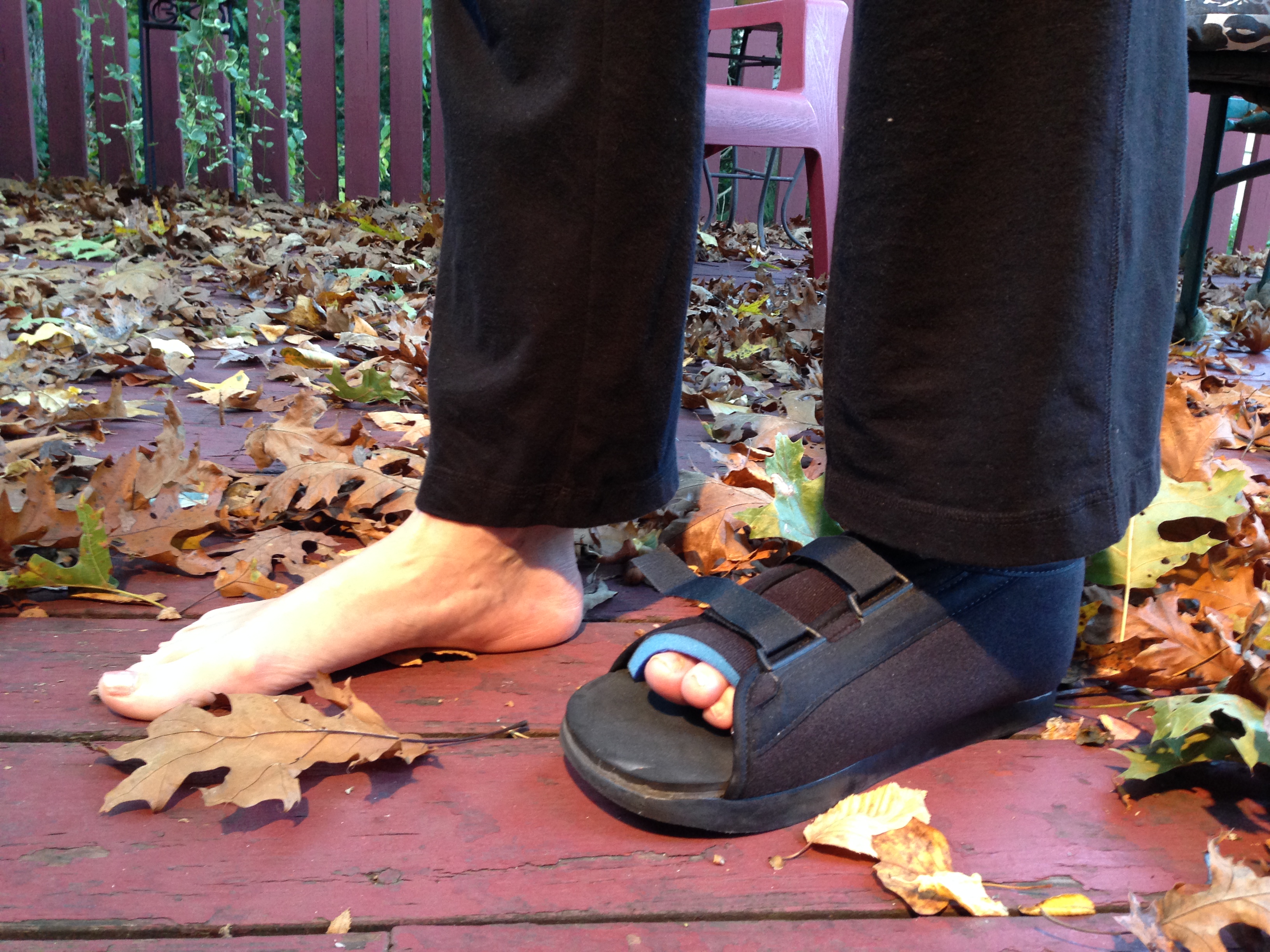
Two weeks ago after returning from a trip we put both the yard and house back in order. I stumbled to bed exhausted and stubbed my toe.

“I think it’s broken,” I wailed.

Rob ran downstairs and fetched a bag of ice.

“They can’t do anything for a broken toe,” he said, laying the ice pack over my blue toes and handing me two Motrin.

“Nothing?”

“Just gotta suck it up.”

Image

After a few days of rest and ice everyone expects you to get back to business. It’s not a big enough injury to curry favor but it nags at you and impedes everyday activities that you still seem to be able to do. You hobble off to work and home again. Only now the dust collects in the corners and leaves pile up outside. You groan at the exertion it will take to simply gather up the pieces of the Sunday paper spread across the living room floor.

My stepfather called and said it best. “A broken toe is nothing more than a nuisance.”

“That’s it,” I exclaimed.

I repeated that all week long when people shook their heads in understanding as I dragged my foot along. “Just a nuisance,” I said, to let them off the hook. They are also tired of my toe.

I collapsed late Friday afternoon on a kitchen stool and stared out at the lake. The distance of the dock is foreboding and off limits. It may as well belong to someone else. I try to remain satisfied with the view but find myself daydreaming about my real life that just hasn’t started yet.

Image

TEA WITH NO TEMPTATIONS

Image

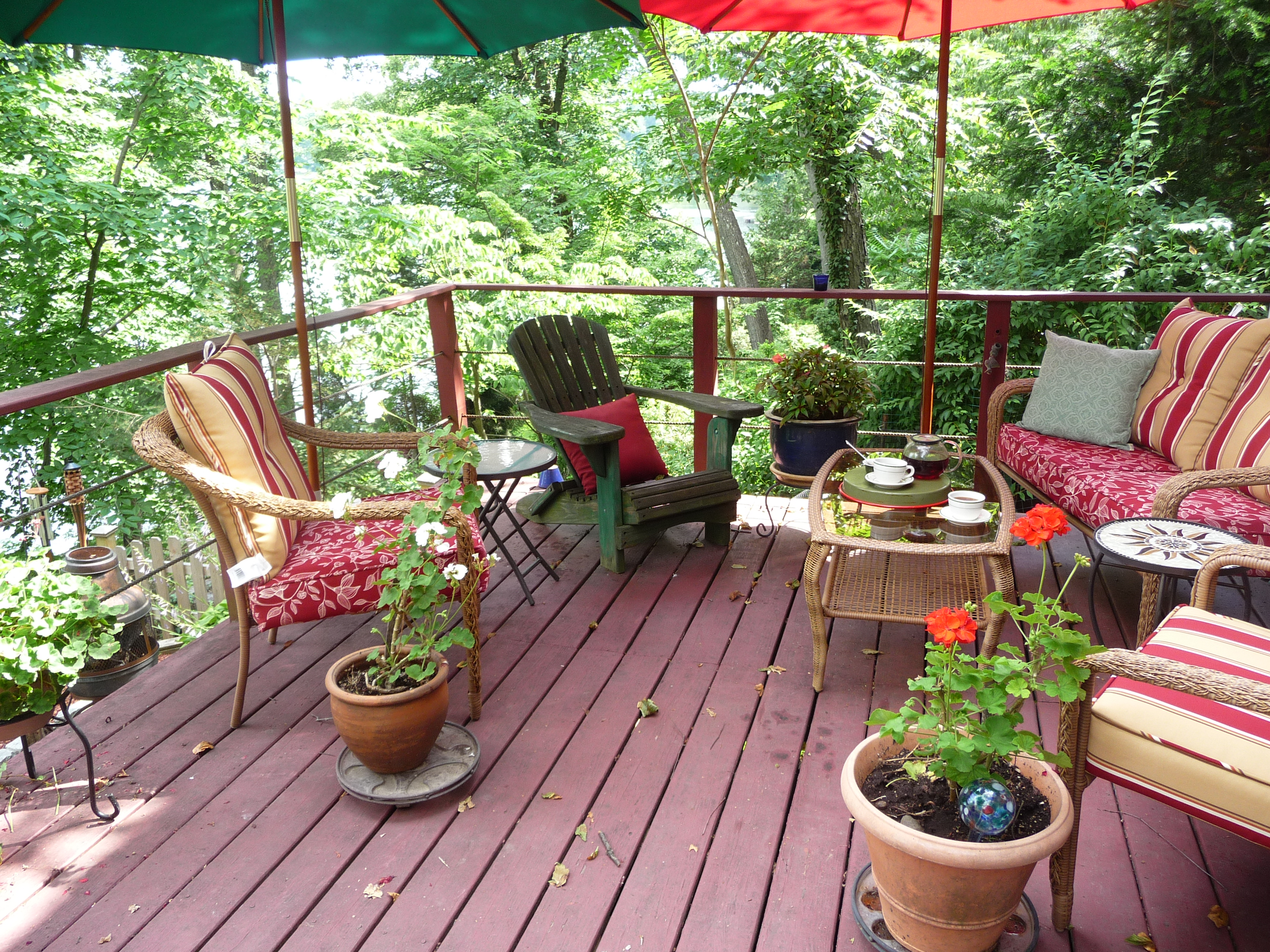
Summer is over and as each work day winds down the pleasure of tea on the lower deck watching people fish in small electric motored boats helps me get to the end of a long day.  The days are shorter and the length of time we have to linger outdoors is slipping deeper into fall. More leaves are still on the trees than off so a blog about raking is still to come.

When the weather grows cooler we’ll move inside and watch the heron float across the water from the kitchen window as we re-infuse our morning pot of green tea for an afternoon pick-me-up.

Tea in the afternoon has long been my excuse to stop everything and eat sweets. The trouble is, like everyone, I really shouldn’t eat sweets so I try not to. Most days I just drink the tea and head out for a walk.

My mother in law was a first generation Italian woman who thought that coffee and cake was a cure for just about anything that ailed you. Showing up at her house in the afternoon I could pretty much count on a hot cup of coffee and a piece of carrot cake and warm conversations. In her later years she couldn’t remember why things worked the way they did. Like how the trees grew all those leaves or how they put a carrot into a cake.

“Carrots in a cake?” she would exclaim. “I just can’t picture it.”

“They shred them.”

“Shred them? What’s that?”

I saw we weren’t getting anywhere. “They just call it carrot cake because it’s orange like a carrot.”

“Okay, that makes sense,” she said.

“Doesn’t it?” my husband sighed as he cut another piece.

Old habits die hard and I think we keep up the tradition of tea time in some sort of misshapen loyalty to her coffee and cake routine.

However, the old adage that some calories just aren’t worth it, is true. Like an Entenmann’s brownie is not worth one morsel of the calorie or sugar count. The opposite is also true. Some temptations have more value than others like a dessert that reminds you of childhood.

But I seem to have the worst timing for when to be good or bad.

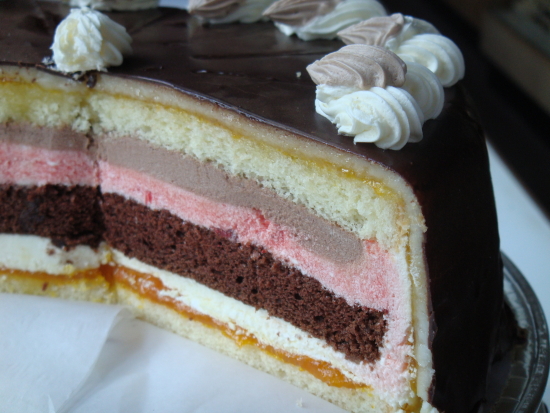
Eight years ago we were traveling home from Cooperstown and we stopped off at Hartmann’s Kaffeehaus in Round Top, New York for coffee. We found the shop in Fodor’s New York which wrote, Desserts are serious business at this simple cafe-bakery, where a “periodic table” of sweets hangs on the wall. The Fürst Pückler torte—layers of marzipan, butter cream, sponge cake, and apricot jam—could put you into sugar shock.

Image

“That sounds too sweet,” I said as the waitress waited for my choice. “I’ll have the sugar free strudel.”

The plates arrived and for the next half an hour I listened to my family moan in ecstasy with each mouthful.

“It can’t be that good.”

“Better,” my son said.

“Think of the best dessert you ever tasted,” he said closing his eyes and smiling as he swallowed. “This is better.”

“Ten times better,” my daughter added.

Rob rubbed it in more. “I’d let you try some but there’s so many different areas to taste you wouldn’t get the full effect.”

“No, I’m good.” I said picking over my dried out, sugar free apple strudel.

Just when i think I’m done regretting that experience they keep pulling me back in. Recently we were in Gleasons and they offered for one day only; homemade pistachio ice cream inside an anise flavored pizzele with a thin layer of chocolate.

“Those are my three favorite things,” Rob said.

I agreed to split one.

“This is delicious,” I said.

“It is,” Rob agreed.

I could sense something.

“But…?” I prodded.

“But nothing will ever compare to that marzipan cake we ate that time in the Catskills.”

I don’t know why I even bother because I certainly don’t need the calories. I also don’t know who is better off. Me who never tasted it and doesn’t know what I’m missing or my family who understands that nothing will ever measure up to The Fürst Pückler.